







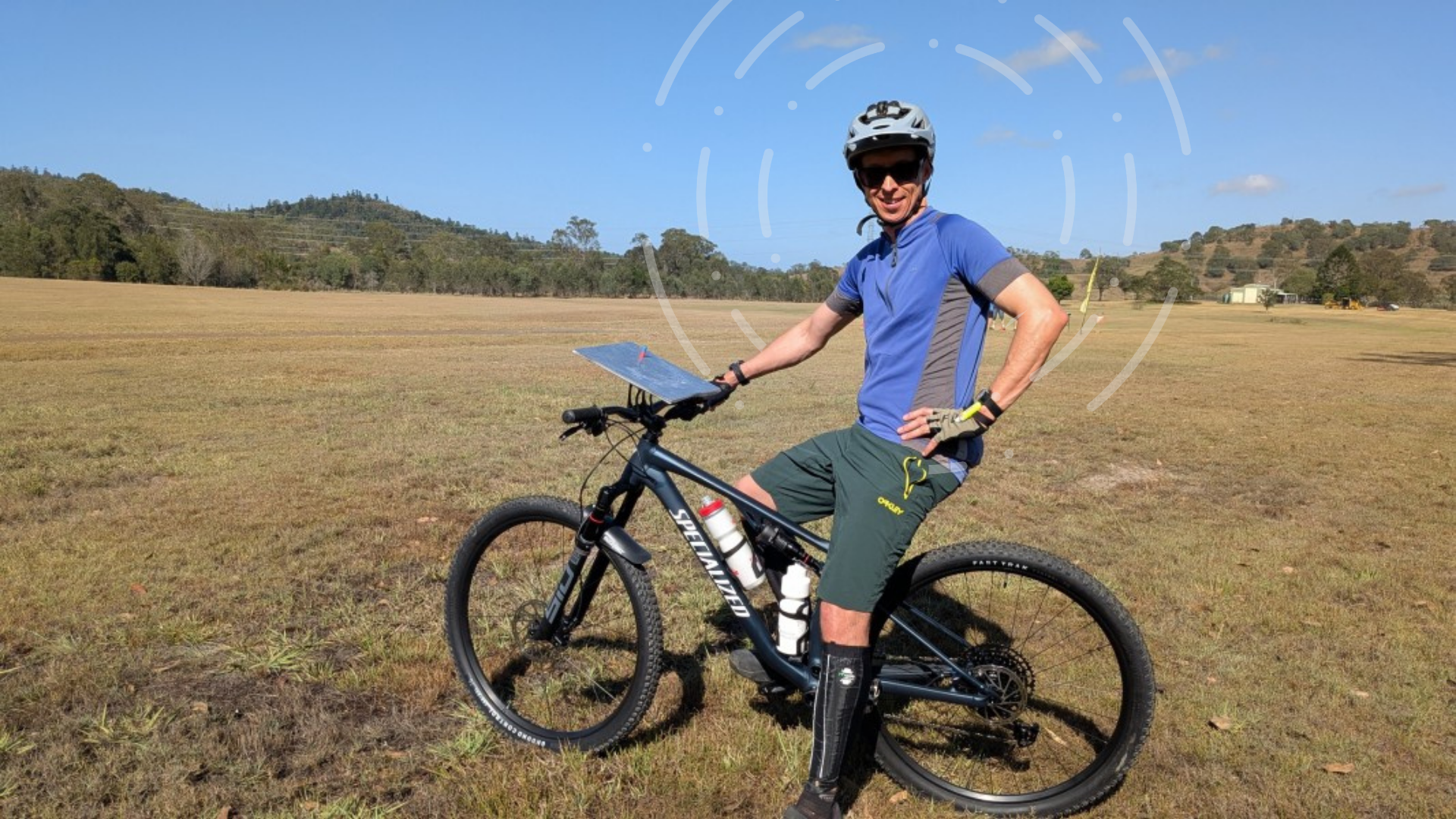
Life is a curious teacher. What we learn from one part of our life may help us in the other things we do. So here are five leadership lessons I learnt from mountain biking.
#1 Focus intensely on what is in front of you but remember to look up regularly
I love mountain ridges. I truly feel connected to the mountain as it drops away on either side. I've hiked beautiful ridges in many different places but what I have never done is ride a bike down one.
Until now.
Above Queenstown, New Zealand, is Ben Lomond, a striking mountain that rises 1748m directly above Lake Wakatipu. It's a popular day hike that you can also ride on a mountain bike. It was a brutal one hour climb in granny gear the whole way. My heart rate averaged 160bpm. Then we reached the saddle and turned around to ride the single track back down the mountain.
The views were majestic, looking down on Queenstown and the lake from up high with just a bare tundra-like ridge ahead. On that ridge was a silver slither of a path. It looked beautiful and easy. It wasn't. The track was terrifyingly narrow with loose rock and shale throughout. I had to force myself to slow every now and then so I could glance up and absorb the view.
Similarly, our leadership roles contain so much stuff that demands our attention - the loose rock and sharp shale. Client demands, deadlines for reports, staff challenges - the list goes on.
You have to make time to look up, to glance at the strategy of your team, division, organisation and industry. Otherwise, how will you know you are riding down the right ridge? Once a day, once a week, definitely once a month, set a small amount of time to think. It's what leaders are paid for.
#2 You need a cheer squad
I only started mountain biking when I was 33 years old. My son, Ashton, loved his bike so I rode with him. He then started riding intermediate trails, so I followed him. He upgraded his bike and I did the same. Then he progressed to harder and harder trails and I tried to keep up.
The end result is that I'm now a much better rider than I ever thought I would be. I go fast down single track, throwing my bike around corners, smiling with glee.
But I don't do jumps.
I like my wheels on the ground where I have an illusion of control. Jumps scare me. It's not taking off that I'm worried about, it's the landing. My fear stems from a broken rib, smashed face, and cracked sternum when twice I've 'fallen' off a drop, not realising it was there to be jumped instead. Yeah, I'm not a quick learner.
But as I've got faster down the hills, jumps are inevitable. Hitting a jump at speed will lift the bike off the ground. I can't avoid physics, so I asked Ashton to help me. He gave me just one piece of advice - stay strong as you approach the jump and let the jump naturally take you up and then down.
Then he followed me down a jump line in New Zealand and cheered me on. He shouted compliments on every jump I hit; he constantly reassured me. He whooped with delight when I did a double wheel skid around a corner. He believed in me.
And I jumped. Boy did I jump. I got to the end of the trail and immediately burst into tears from sheer relief and adrenaline. I couldn't have done it without him.
So, who is your cheer squad? Leadership, like riding a bike, is a lonely activity. You need people around you to reassure you that you are doing the right thing. You need people to give you feedback and suggestions on how to do things differently. You need people to believe in you. Seek these people out and most importantly, spend time with them regularly. It doesn't have to be a huge amount of time, it’s the regularity that's important.
#3 Keep your confidence below your capability
This is my mountain biking mantra. I'll tell it to anyone who rides. At the end of the day, mountain biking is a dangerous activity. Those two wheels aren't all that wide and it's quite easy to fall off. Often, it's the things that are outside of your control that cause an accident: loose slippery gravel; a branch fallen across the track around a blind corner (once that branch turned out to be two-metre python!); or a puncture.
The bad accidents are usually caused by over-confidence. Riding a steep trail you just aren't skilled enough for. Hitting a jump that is too high.
In these situations, you get hurt. In leadership, you're more likely to hurt others. By default, as leaders we have some power and influence. How we exercise this influence affects others. Our behaviours can do damage. Reflect on how you respond when something goes wrong. How did you approach that huge project you were handed and felt out of your depth?
It is easy to think that we are a better leader than we are. After all, research shows that 75% of people think that they are an above-average driver. We have a bias to see ourselves in a positive light.
Leadership takes practice and we build up our skills gradually over time. Pay attention to how your sense of self, attitudes and behaviours are changing over time. It takes time to develop our leadership effectiveness and we only learn when we reflect and seek feedback from others.
#4 You can't go fast all the time, your body will fail
I'm a goofy foot. Believe it or not, that's a technical term to describe a person who has a different dominant foot. Most right-handed people ride with their right foot forward. I ride with my right foot back. It's the same for any board sports like skateboarding, snowboarding or surfing (not that I can claim any skill in those whatsoever). What it means is that when I ride downhill most of my weight is on my right leg. Downhill riding does not involve much peddling as you are basically in the squat position for the entire way down the mountain.
In November 2024, I did this for 10 hours a day for 3 days straight. I was at Thredbo in the Victorian Alps, and we caught the chairlift up to the top, then rode 5 to 10 kms down to the bottom. Then got back on the chairlift and repeated.
I didn't realise that my right hip flexor had significantly tightened and that my back muscles had grown out of alignment to compensate for the constant squatting position on the bike.
Three weeks later, I bent to tie my shoe and blew a disc in my back.
It's not an uncommon injury but it's very painful and so inconvenient. I sat with a hot water bottle at my desk for two months.
You can't go fast all the time. Leadership is intense. It's game on every day. Like mountain biking, if you lose concentration or focus, bad things will happen. The exhilaration is part of the attraction of leadership roles. There is no shortage of challenge, or adrenaline or dopamine hits.
But it takes its toll. You get sick more often, that niggle in your body gets worse, your positivity starts to wane.
Play the long game. Leadership, as a profession, is a lifelong commitment to serve others. You have to be healthy and strong to be able to do so. Start by building in recovery so that you can go fast when you need. Don't just recover after you've burnt out.
#5 What you focus on is what you get
After his accident, Ashton told me that on the previous two runs of the same trail, that particular tree got closer and closer. So that on the third run when he came out of the corner at speed and went up the jump, he glanced at the tree.
Then hit it with his handlebar.
It was quite an impressive stack as he flew in a separate direction to his bike and then somersaulted three times down the trail and landed on his feet. Fortunately, there were no serious injuries apart from a bruised shoulder and hip (which were a bit painful carrying a 15kg backpack on our hike the following days).
What you focus on is what you get.
What is your conception of what it means to be a leader? If you see your role is to make sure people are doing the right things and to fix things, then you will see problems and people not meeting your expectations.
If your role as a leader is to motivate people around a shared goal, then you will see your team doing amazing things. As you acknowledge these things then a positive reinforcement loop takes place and you'll see more. It's more than psychological safety, it's creating a place where people can experience meaningful work.
Just don't hit the tree.
%20-%20Copy%20(2).jpg)
Edwin is the CEO of Trevor-Roberts and has spent the last 2 decades exploring how people find meaning through their work. He is also Chair of the Advisory board at the Centre for Work, Organisation, and Wellbeing at Griffith University.