







The Surprising Power of Individual Agency: Lessons from Nepal’s Forest Regeneration
When we think of solving large-scale societal challenges, it’s tempting to envision sweeping government policies, international accords, or impressive new technologies. Yet, the story of Nepal’s remarkable forest regeneration offers a surprising lesson: empowering individuals within a decentralised system can achieve extraordinary results. It’s a case study of how the collective agency of individuals can drive societal transformation, challenging conventional assumptions about where solutions to complex problems lie. It’s also a sobering lesson in leadership.
A Vanishing Resource
In the mid-20th century, Nepal’s forests were on the brink of collapse. Decades of overharvesting for timber, agriculture, and firewood had devastated the landscape. Forest cover, which once blanketed much of the country, had dwindled precipitously with rural communities bearing the brunt of the environmental degradation. Landslides became more frequent, water sources dried up, and biodiversity suffered. Most alarmingly, the loss of forest resources jeopardised the livelihoods of millions who relied on them for fuel, fodder, and building materials. Nepal was one of the poorest countries in the world relying on the support of international NGOs such as the Australian Himalayan Foundationi.
The government’s initial response was predictable but ineffective: strict centralisation of forest management. Under state control forests were declared national property and local communities were excluded from their stewardship. This approach, however, exacerbated the problem. Locals, cut off from their traditional forest management practices, saw little incentive to conserve resources and often resorted to illegal logging to meet their needs. By the 1970s, deforestation seemed an intractable crisis.
Radical Re-think of Stewardship
Faced with the failure of centralisation, Nepal’s policymakers pivoted in the late 1970s. Recognising the futility of excluding communities from forest management, they did a 180 degree turn to decentralisation. Under new legislation, local communities were granted the right to manage and utilise forests sustainably through community forestry programs.
This is agency at scale.
The concept was simple yet radical. Forest User Groups (FUGs), composed of local villagers, were given responsibility for protecting and regenerating nearby forest areas. These groups received training and legal authority to make decisions about harvesting, conservation, and equitable resource distribution. Crucially, they retained a significant share of the economic benefits derived from the forests, aligning their incentives with long-term sustainability.
This shift was not merely a policy change but a transfer of agency. By empowering individuals to act as stewards of their environment, the program unleashed a wave of grassroots ingenuity, accountability, and commitment.
Forests Reborn
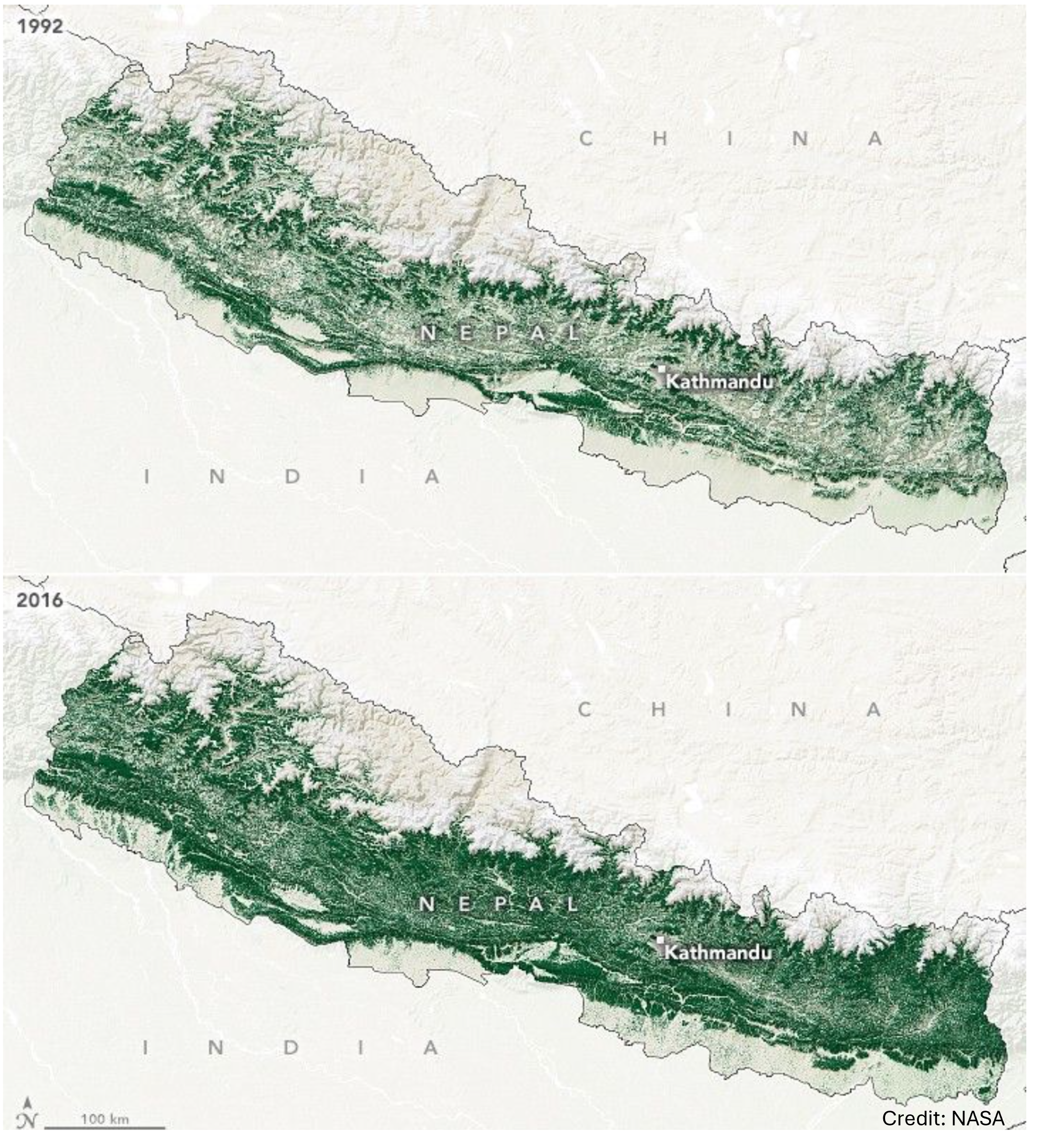
The results of Nepal’s community forestry initiative have been nothing short of extraordinary. Since the program’s inception, over 22,000 Forest User Groups have been established, managing approximately 40% of the country’s forests. Satellite imagery and field studies reveal a significant increase in forest cover over the past four decades. According to NASA’s Earth Observatory, much of Nepal’s forested areas are healthier and denser than they’ve been in living memory.
The benefits extend beyond ecological recovery. Rural communities have seen improved livelihoods through sustainable timber sales, non-timber forest products, and ecotourism initiatives. The program has also fostered social cohesion and empowered marginalised groups, including women, who play a prominent role in many Forest User Groups. What’s remarkable is that these gains have been achieved not through top-down mandates but through the cumulative actions of individuals exercising agency within a supportive framework.
Why This Matters: A Broader Lesson on Agency
Nepal’s story underscores a profound truth: when individuals are empowered to act with autonomy and purpose, their collective efforts can address even the most daunting societal challenges. This principle, though deceptively simple, often runs counter to prevailing instincts in leadership, governance and problem-solving. Institutions frequently default to centralised control, assuming that large-scale problems require equally large-scale interventions. But such approaches can inadvertently stifle the very resourcefulness and ownership needed to drive meaningful change.
The same thing happens in our organisations.
Individual agency thrives in environments where people have both the authority to act and a stake in the outcomes. Nepal’s community forestry model exemplifies this dynamic. By decentralising decision-making and aligning incentives, it turned villagers from reluctant rule-breakers into proactive guardians of their environment. The program’s success demonstrates that large-scale progress often depends on small-scale actions, coordinated and amplified through systems that prioritise empowerment over enforcement.
Implications for Leadership in Organisations
Our organisational models tend to mirror the centralised governance structures that initially failed in Nepal. We may talk about removing bureaucracy and decentralising yet the reality is that leaders often assume that effective solutions require top-down control, directives, and oversight. However, this approach undermines creativity, ownership, and accountability - the very qualities that drive success in complex environments.
The example of Nepal invites leaders to reconsider their role, shifting from command-and-control to facilitators of individual and collective agency. By decentralising decision-making, providing resources and training, and aligning incentives with desired outcomes – in other words building agency – leaders can empower employees to take initiative and innovate.
Moreover, embracing this mindset requires leaders to challenge biases about where expertise resides. Employees at all levels of an organisation possess insights and solutions that often go untapped just as rural villagers proved to be capable stewards of Nepal’s forests. This shift necessitates that leaders let go of their authority and trust the expertise of others.
This requires great courage.
When we relinquish control, we have to listen. When we listen we create the space for experimentation. When we experiment, the best ideas emerge. These ideas help our clients and in doing so achieve the impact we so fervently want to make.
Imagine for a moment that all our organisations took such an approach. Then we would see the power of how agency, when multiplied, can transform societies.
Now its your turn.
%20-%20Copy%20(2).jpg)
Edwin is the CEO of Trevor-Roberts and has spent the last 2 decades exploring how people find meaning through their work. He is also Chair of the Advisory board at the Centre for Work, Organisation, and Wellbeing at Griffith University.